Transformation as a tradition – Volkswagen Commercial Vehicles is celebrating the 70th anniversary of its plant in Hanover

6 March 2026
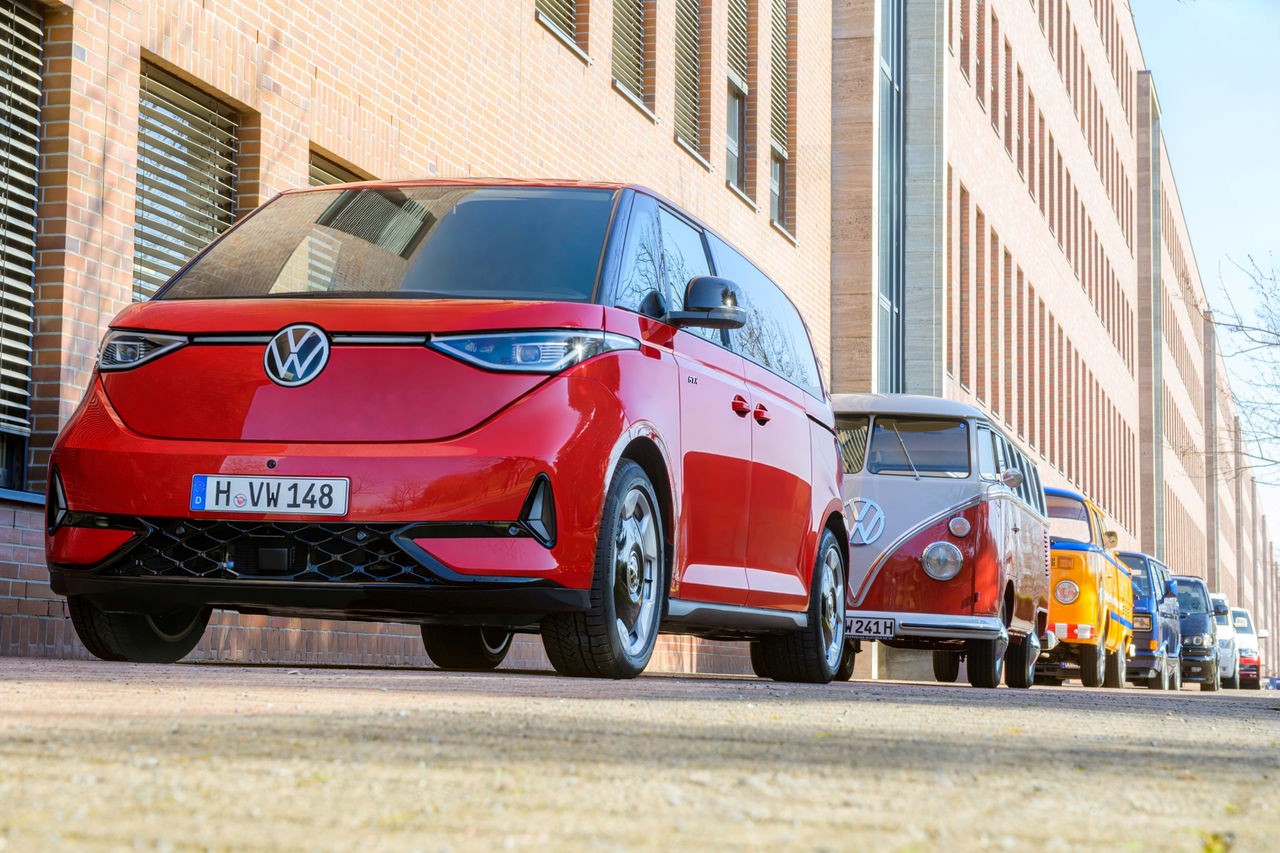
- Economic miracle: on 8 March 1956, production of the legendary T1 Transporter began in the state capital of Lower Saxony VW Bus plant: to this day, the Hanover plant remains closely associated with the VW Bus. In 2026, the ID. Buzz, Multivan and California are being built here
- Plant for the future: pre-series production of the fully autonomous ID. Buzz AD is starting in Hanover – for the first time in Europe, a roboshuttle with Mobileye technology will be built on a larger scale traction
Hanover, 6 March 2026 – Volkswagen Commercial Vehicles is celebrating ‘70 years of the Hanover plant’ this coming Sunday – 8 March. On this day in 1956, production of the legendary T1 Transporter started in what is today the brand’s main plant. In 2026, it is one of the most modern automotive factories in Europe. Oliver Blume, Chair of the Board of Management of Volkswagen AG, says: “The plant in Hanover represents a long‑standing tradition combined with technological progress. It has successfully established itself as a centre for electric mobility while at the same time supporting all types of powertrains. Founded in 1956, the plant will produce its eleven millionth vehicle this year. In 2027, the team in Hanover will begin series production of the ID. Buzz AD – the first fully autonomous series‑production vehicle in Europe.” Pre-series production of the fully autonomous ID. Buzz is already underway at the plant, marking the next step on the road to industrialising autonomous mobility in Europe.
E-mobility plant: Stefan Mecha, Chair of the Board of Management of Volkswagen Commercial Vehicles, says: “The Hanover plant is a key location for our transformation. Here, we produce the Multivan with efficient diesel and plug‑in hybrid powertrains, alongside the all‑electric ID. Buzz and ID. Buzz Cargo. Vehicles built in Hanover have long set benchmarks in their segment and are a hallmark of the Volkswagen Commercial Vehicles brand. Today, we are laying the foundation for climate‑friendly mobility in the future.”
Richard Slovak, Plant Manager in Hanover, adds: “All of this is made possible by our employees at our Hanover site – with great commitment and outstanding expertise, they ensure that high‑tech models such as the ID. Buzz and the new Multivan eHybrid 4MOTION are built here.”
Stavros Christidis, Chairman of the Works Council at Volkswagen Commercial Vehicles Hanover: “Nearly eleven million vehicles have been built here over the past 70 years, by great people who bring this plant to life day after day. The pressure on the automotive industry is immense. But the Hanover plant is not just a factory – it is a community. A part of Hanover’s family history for tens of thousands of people, in some cases across three generations. Every hall, every assembly line at this site tells stories of people who achieve extraordinary things and who stand together – in good times and in challenging ones. This attitude is what defines Volkswagen Commercial Vehicles. We can be proud of this success story, and it is also a mandate for our future.”
Pioneering in sustainable production: Volkswagen Commercial Vehicles is also consistently driving forward the sustainable transformation of the Hanover plant. The company is thus charting its course toward the goal of carbon-neutral production by 2040.
Steffen Reiche, Member of the Brand Board of Management responsible for Production and Logistics at Volkswagen Commercial Vehicles, says: “At our Hanover site, we rely exclusively on green electricity and a biomass‑fired combined heat and power plant. Our goal is climate‑neutral production at all locations by 2040 – including Hanover – while creating regional value, securing jobs and actively contributing to climate protection.”
Pre-series production of the fully autonomous ID. Buzz is starting: the ramp-up for pre-series production of the fully autonomous ID. Buzz is now underway in Hanover. This step is the start of the industrialisation phase. For the first time, a roboshuttle with Mobileye technology will be produced in Europe on a large scale. The vehicles are part of the MOIA Turnkey Solution, an integrated overall solution from the Volkswagen Group subsidiary that bundles vehicles, autonomous driving systems, software-based fleet control and operator services for autonomous mobility services in cities. Over the course of the year, pre-series production at the Hanover plant will be ramped up to around 500 vehicles, which are planned for various projects in Europe and the USA. Incidentally, the self-driving vehicles pass through the same production sections as all non-autonomous ID. Buzz models. An additional production loop is planned for installation of specific components such as the combined roof module with cameras, radar and lidar units as well as the high-performance computer on the front passenger side, the end of which is marked by sensor calibration and commissioning of the respective vehicle. By embedding the vehicle in series production, which will start in 2027, Volkswagen Commercial Vehicles will be able to produce large quantities of fully autonomous vehicles for the global market as required.
Group Components: technological driving force and strong partner at the Hanover site: Volkswagen Group Components is part of Volkswagen Group Technology and thus plays a key role in the Group’s e‑mobility strategy. This strength is demonstrated by the close cooperation at the Hanover site. The local battery system production (NMC) supplies vehicle assembly directly and benefits from short distances.
The upcoming update of battery system production based on the Cell‑to‑Pack design and unified cell will accelerate technological progress and strengthen the Group’s resilience. Expansion of battery system production in Hanover will start during the course of the year, allowing for the production of additional cell chemistries (LFP and NMC) in the future. The maximum production capacity will increase by 50 per cent, meaning that four Group brands will be supplied at seven locations in the future. Development takes place in the pre-production centre in Braunschweig. The new MEB+ battery system is already being implemented at locations in Spain and the Czech Republic; the unified cell comes from both PowerCo and external partners. In addition, Group Components is currently supplying the ID. Buzz People and ID. Buzz Cargo entirely with rear and front axles from Barsinghausen. The portfolio also includes the Performance front axle (all‑wheel drive) and the axles for the ID. Buzz AD.
How it all began: seven decades ago, the construction of the Volkswagen plant in Hanover was based on the great success of the T1 – the first Volkswagen Transporter. It had been initially built together with the Beetle in Wolfsburg since 1950. But demand quickly exceeded production capacities. In 1955, Heinrich Nordhoff, then Managing Director of Volkswagenwerk AG, therefore decided to build a separate plant in Hanover. This was achieved at German economic miracle speed in just one year – the first T1 left the production line on the above-mentioned date of 8 March 1956.
Logistically perfect location: the location of the plant in Hanover was anything but a random choice. It is only an hour’s drive from the Group headquarters in Wolfsburg and is logistically connected to the most important transport routes: via the motorways in the immediate vicinity to the major roads and via its own plant railway to the rail network – and back then still important: via the Mittelland Canal directly at the plant to the European waterway network. Thanks to this forward-looking logistical networking, the plant has been able to supply all conceivable markets in Europe and the world for 70 years.
70 years of Hanover, seven generations of the VW Bus: the history of the Hanover plant is still closely linked to the model history of the VW Bus up to the present day. After the first generation of the T1, its successors – from the T2 to the T6.1 – were also built in Hanover. The seventh generation of the iconic product line today consists of three pillars: the ID. Buzz, the Multivan and the Transporter/Caravelle. Two of these pillars, the state-of-the-art and all-electric ID. Buzz and its commercial vehicle variant, the ID. Buzz Cargo, as well as the Multivan, are produced in Hanover. Both models are becoming increasingly important. Taking the ID. Buzz as an example: in 2025 alone, it achieved growth of 102 per cent compared with the previous year. It also heralded the comeback of the VW Bus in America – the models for the USA and Canada are also produced in Hanover. For the ID. Buzz product line, the plant has in recent years been transformed into an e-mobility location through the major developments outlined above and with high investments. This is also why it is now one of the most modern automotive plants in Europe. The Multivan also recorded significant growth of 31 per cent in 2025. This vehicle also forms the basis for the latest California generation, introduced in 2024. From the summer of 2026, production of the iconic camper van will be fully integrated into the main plant in Hanover from the external location in the Limmer district.
Around 13,000 people currently work for the Volkswagen Commercial Vehicles brand and Volkswagen Group Components at the Hanover site, which covers an area of approximately 1.1 million square metres.
Further photos, footage, and texts (VWN chronicle, plant chronicle, and the story “How the Bulli came to Hanover”) are available on the “70 Years of the Hanover Plant” landing page in VWN’s press database.
(ends)
Space for Needs and Dreams: Creating the Future since 1950.
For over 75 years, the VW Bus has stood for reliability and versatility – initially in commercial use and today also in everyday family life and camping. Now in its seventh generation, the concept continues to impress: as reliable Transporter, versatile Multivan, adventurous California, or fully electric ID. Buzz. Whether as a mobile workshop, trusted service vehicle, or utility-driven everyday hero – the vehicles by Volkswagen Commercial Vehicles offer space for needs and dreams and are in use worldwide for people on a mission.
At the sites in Hanover (Germany), Poznań (Poland), and Września (Poland), more than 21,000 employees produce vehicles for both commercial and private customers. Transporter, Caravelle, Multivan, Caddy, Crafter, California, Amarok, and the ID. Buzz delight and inspire customers every day. With the ID. Buzz AD, Volkswagen Commercial Vehicles is producing the first fully autonomous production vehicle in Europe and shaping the future of mobility as a manufacturer. Headquartered in Hanover, the brand is shaping the mobility of today and tomorrow – meeting all the demands for clean, intelligent, and sustainable mobility. This is what Volkswagen Commercial Vehicles stands for with its brand promise: success, freedom, future.
About the VW Bus
Since 1950, the iconic VW Bus from Volkswagen Commercial Vehicles has been moving people and goods worldwide. Over 12.5 million vehicles across seven generations have been built, most of them at the brand's main plant in Hanover, Germany. The success of the VW Bus is unique in automotive history: it was a symbol of the ‘economic miracle’ and the hippie movement, and to this day stands for reliability, freedom and adventure. Whether fully electric as the ID. Buzz, versatile as the Multivan, adventure-ready as the California, or as a reliable New Transporter – the current models continually set benchmarks in technology and functionality, while consistently continuing the design tradition. Today, the ID. Buzz AD drives autonomously, marking the next milestone in the Bus’s history: with sustainable mobility and transport solutions for people and goods worldwide.
Contact
Chris Yan
Head of Product Communications, VWCV,
Digital & Brand Experience
Phone: +49 152 229 956 03
E-mail: chris.yan@volkswagen.de
Tim Fronzek
Product Communications Spokesperson
for VW Bus family (ID. Buzz, Multivan and
Transporter)
Phone: +49 152 588 725 78
E-mail: tim.fronzek@volkswagen.de
010/03.2026/JK
Photos (9)
Originally published by Volkswagen
View original article →
Tags
Spotted an issue with this article, or is this your material? Rights holders