Brand Group Core boosts operating result in first half – new Core Executive Committee strengthens cross-brand cooperation

24 July 2026
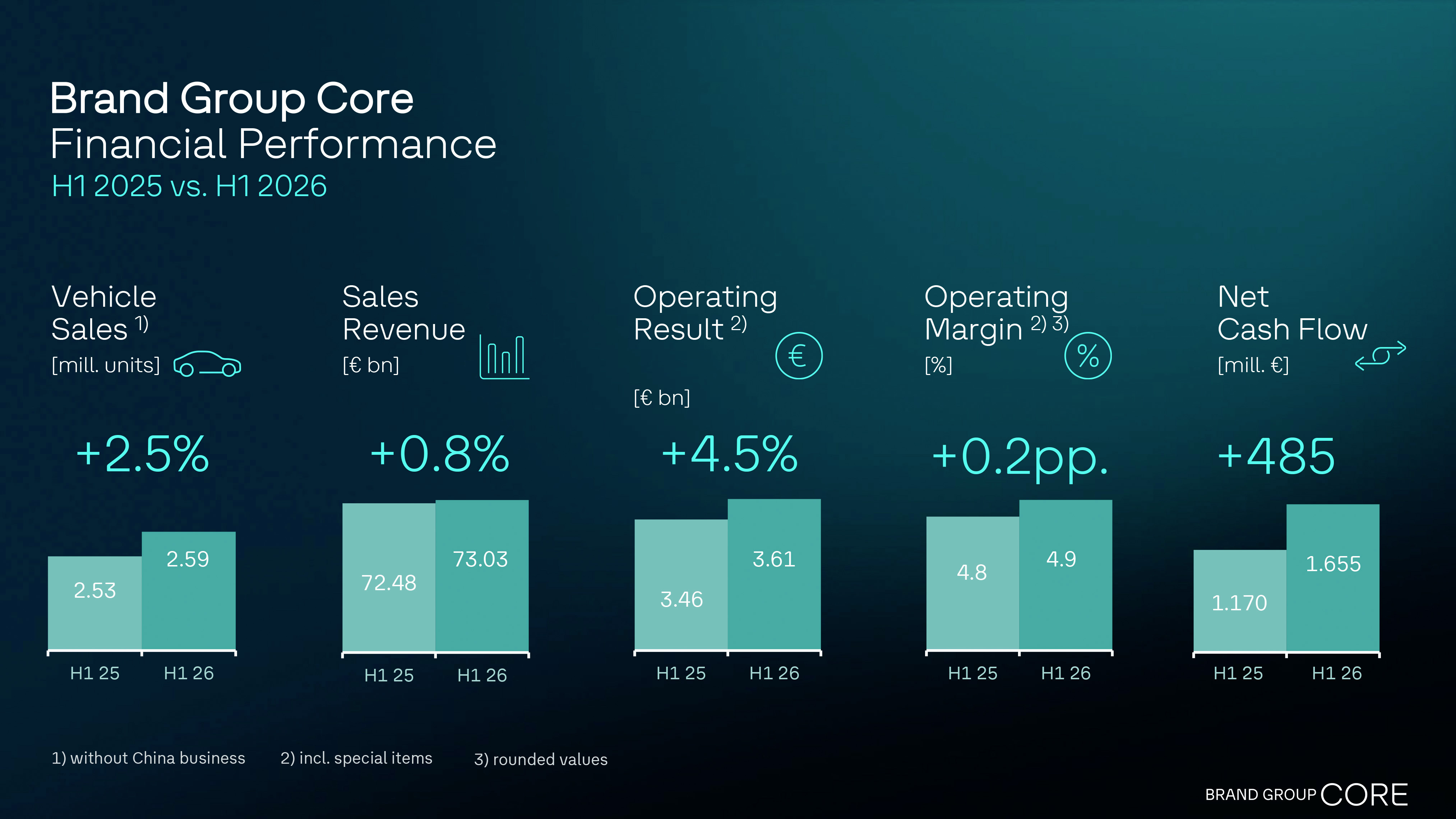
The Brand Group Core (BGC), the organizational entity combining the volume brands of the Volkswagen Group, recorded an operating result of 3.61 billion euros in the first half of 2026, 4.5 percent more than in the corresponding prior-year period. Year-on-year, the operating margin improved slightly to 4.9 percent.
In an environment that continued to be characterized by US import tariffs and growing competitive pressure, consistent cost control and reinforced cooperation had a positive impact on the half-year result. Nevertheless, geopolitical crises continue to have a negative impact on markets and supply chains. Regulatory requirements and barriers to trade are growing. In addition, there are far-reaching market upheavals throughout the world. The BGC intends to position itself even more efficiently and robustly and is aiming to achieve further cost savings and to reduce the complexity of processes, structures and products.
For this reason, the newly created Core Executive Committee, comprising the CEOs of the volume brands (Thomas Schäfer/Volkswagen, Klaus Zellmer/Škoda, Markus Haupt/ SEAT&CUPRA, Stefan Mecha/VW Commercial Vehicles) and the heads of the BGC functions Finance (David Powels), Procurement (Karsten Schnake), Production (Christian Vollmer) and Technical Development (Kai Grünitz), started work at the beginning of July. This is connected with a changed management structure with clearly assigned competences and growing regional responsibility in the volume brand group of the Volkswagen Group.
“The results of the first half show that our cooperation as a brand group is effective and is targeted towards joint success. This approach is increasingly bearing fruit. Nevertheless, geopolitical crises and far-reaching market upheavals continue to have an adverse impact on our business. With the new Core Executive Committee, we are therefore taking the next organizational step from July onwards:
Clear responsibilities, slimmer management bodies and optimized cooperation in the fields of production, procurement and development. We know that the global challenges will continue to grow – we can therefore only be successful through consistent cooperation and leveraging synergies.”
Thomas Schäfer, Member of the Group Board of Management, CEO Volkswagen Passenger Cars Brand
“The financial picture for the first half of 2026 is mixed. Thanks to consistent work on costs, especially as a result of our performance programs, we were able to compensate for special items such as costs in connection with the discontinuation of ID.4 production in North America and to record a slight improvement in our operating result compared with the first half of 2025. However, the fact that the increase in sales revenue lagged behind the rise in unit sales shows just how challenging the economic environment is. The steady growth in competition and the new realities of the global economy are calling upon us to make our business model significantly more robust in order to be well-prepared for the future and sustainably successful. To achieve sustained improvement in our competitiveness by 2030, we must and will tap the significant additional potentials available in terms of cost, complexity and cooperation. Where we are steering together as a brand group, the efficiency improvements and scale effects are now becoming increasingly apparent.”
David Powels, CFO Volkswagen Passenger Cars Brand & Brand Group Core
|
Unit sales of Brand Group Core |
Growth was driven by higher unit sales at Škoda, SEAT&CUPRA and Volkswagen Passenger Cars, as well as strong demand for BEVs – especially the Volkswagen ID.3 and Škoda Elroq. In the first few weeks following the market launch, the level of orders received for new Electric Urban Car Family has been very good in overall terms. |
|
|
Sales revenue of Brand Group Core |
Growth at Škoda and SEAT&CUPRA was more than sufficient to compensate for the falls at Volkswagen Passenger Cars and Commercial Vehicles and lifted the total sales revenue of the brand group slightly above the prior-year level. |
|
|
Operating result of Brand Group Core |
The improvement in the operating result was due to factors including efficiency programs and closer cross-brand cooperation. US import tariffs and costs in connection with the discontinuation of ID.4 production at Chattanooga continued to have an adverse impact. |
|
|
Operating margin of Brand Group |
There was a slight rise in the operating margin. Without the costs of restructuring and the discontinuation of ID.4 production in the USA, the margin of the BGC would be 5.9%. |
|
|
Net cash flow rose to1.66 billion euros |
The net cash flow of the BGC improved significantly compared with the prior-year period as a result of disciplined control of inventory, investments in |
Review of the first half of 2026
In the first half of 2026, the Brand Group Core recorded an improved operating result, demonstrating that the efficiency programs initiated within the volume brands are gaining traction. Nevertheless, the results achieved still lagged significantly behind the brand group’s own ambitions.
With a rise of 8.2% in unit sales, Škoda achieved the most dynamic growth within the brand group. SEAT&CUPRA improved its operating result, continuing the turnaround of the previous quarter.
Volkswagen Commercial Vehicles recorded a significantly higher operating result compared with the prior-year period, with a slight fall in unit sales. In North America, the market environment remains difficult. Sales promotion measures, mix effects and costs in connection with the discontinuation of ID.4 production in Chattanooga were the chief reasons why the operating result of the Volkswagen Passenger Cars brand was slightly below the figure for the first half of 2025.
The Electric Urban Car Family is giving an especially positive signal. The small car family introduced only a few weeks ago has been very well received by customers. More than 70,000 orders have already been received for the attractive entry-level models of VW, Škoda and CUPRA, although only three of the four models planned, the CUPRA Raval, ID. Polo1) and Škoda Epiq, are available as yet.
The operating margin of the Brand Group Core ran at 4.9%. Eliminating the special items mentioned above, the operating performance of the Brand Group Core was 5.9%.
1) ID. Polo (155 kW) - Combined power consumption 14.6-13.3 kWh/100 km; combined CO₂ emissions 0 g/km; CO₂ class: A.
New quality of cooperation within the Brand Group Core from July
The Brand Group Core is consistently continuing its strategy of efficiency improvement and closer cooperation. On the basis of a new cooperation agreement, the organizational linkage of key BGC functions is changing from July 1, with effects on the structures and processes of the participating volume brands Volkswagen Passenger Cars, Škoda, SEAT&CUPRA and Volkswagen Commercial Vehicles.
The new board, the “Core Executive Committee” (CEC), which is comparable with a brand Board of Management at the Brand Group Core level, has now officially assumed its duties. The implementation of this new board is a key step in achieving a new quality of cooperation within the Brand Group Core. A cooperation agreement concluded jointly lays down binding transparency, information and liaison obligations between the brands and functions. This creates a seamless logic, with clear roles and responsibilities across all brands.
In future, the yardstick for cooperation will be the overall optimum for the brand group together with a new culture of joint decision-making. At the same time, the brands Volkswagen Passenger Cars, Škoda, SEAT/CUPRA and Volkswagen Commercial Vehicles will remain autonomous as regards market responsibilities and brand identity.
This new structure is a response to growing competitive pressure and the increasing financial pressure which the brand group faces.
With its agreed strategy “Future Production Governance”, especially the production business area is giving a highly concrete demonstration of how the new steering model functions. The goal is a clear regionally oriented steering approach; in other words, responsibility will be pooled where it is most effective, i.e. in the regions of the world, near to the plants and near to business. In the first half of the year, key structures for this approach were created. The regional managements have been established and are assuming end-to-end responsibility for their production networks. At the same time, key steps were implemented within the organization: the Central Europe region was repositioned; comparable structures are also in place for the Iberian Peninsula and for Central Europe.
The groundwork has now been laid: fewer interfaces, clearer responsibilities and significantly greater steering capability within the regions. Away from complex, separate structures for the brands towards an integrated, high-performance positioning.
In addition, the reorientation of the steering model will provide a cumulative savings potential for the Brand Group Core of 1 billion euros up to 2030 in production alone.
Overview of the brands in the Brand Group Core:
Volkswagen Passenger Cars
Volkswagen Passenger Cars sold 1.530 million vehicles in the first half of 2026, (excluding China, including external manufacturing), a moderate increase of 0.5% compared with the first half of 2025.
In the brand's home region of Europe, the market environment remains difficult. At 42.30 billion euros, sales revenue was below the figure for H1 2025 (43.45 billion euros), reflecting the market environment, which continues to be difficult, and high competitive pressure.
The operating result fell to 995 million euros as a result of adverse effects including costs in connection with the discontinuation of ID.4 production in the USA and further restructuring costs. However, with its performance programs, the brand has laid the strategic foundation for a sustained improvement in its result. The efficiency measures initiated are having a positive effect. The operating margin in H1 was 2.4%. After eliminating the special items mentioned (continuing restructuring costs and expenses in connection with the discontinuation of ID.4 production in the USA), the operating margin of the Volkswagen brand was 3.8%.
Škoda Auto
In the first half of 2026, Škoda Auto confirmed its strong position in the world market and delivered 555,700 vehicles to customers throughout the world, corresponding to a rise of 9.1% compared with H1 2025. In Europe, Škoda Auto remains the second-best-selling brand. Driven by growing customer demand for electric vehicles, deliveries of the all-electric Elroq and Envaq almost doubled, taking Škoda to fourth place among the best-selling BEV brands in Europe. The recently launched BEV models Epiq and Peaq offer further potential for growth – and more than 30,000 orders have already been received for the two models. In the first half of 2026, the sales revenue of Škoda Auto grew to 16.0 billion euros (+6.3%) and the operating result to 1.37 billion euros (+6.3%).
The operating margin remained stable at a solid figure of 8.5%.
These figures were buoyed by higher sales volumes, a more favorable volume mix, the continuous optimization of the product mix, strict cost discipline and the effective leveraging of synergies within the Volkswagen Group and the Brand Group Core.
SEAT/CUPRA
In the first half of 2026, SEAT & CUPRA continued its positive development and recorded an operating result of 122 million euros, 84 million euros more than in H1 2025. Sales revenue grew by 1.3% to 7.7 billion euros. The new corporate strategy strengthened the position of SEAT & CUPRA in an increasingly competitive market environment. As one of the key levers, the performance program continues to bear fruit throughout the world through improved operational efficiency and strict cost discipline, also laying the groundwork for future growth. In addition, the fact that additional EU- import tariffs do not apply to the CUPRA Tavascan had a positive impact on the result.
At 170,100 vehicles sold, the CUPRA brand achieved a record in the first half of 2026. With the beginning of production of the Electric Urban Car Family in Spain, the CUPRA Raval had the most successful market launch in the history of the brand. In the second quarter, the Raval resulted in an increase of 85% in orders received by CUPRA for electric vehicles, further improving the positive prospects of the brand for the year as a whole.
Volkswagen Commercial Vehicles
In the first-half of 2026, Volkswagen Commercial Vehicles delivered about 192,200 vehicles to customers, corresponding to a rise of about 7% compared with the first half of 2025. Especially the share of battery-electric vehicles was further increased. The main factors in this development were the New Transporter and significantly higher deliveries of the ID. Buzz People in Europe.
With a market share of 23.2%, Volkswagen Commercial Vehicles therefore remains the clear market leader in the BEV segment. On the other hand, unit sales, at 216,000 vehicles, were 4% below the figure for the first half of 2025. As a result of the lower volume, sales revenue also fell to 8.2 billion euros (H1 2025 8.7 billion euros). Nevertheless, in direct comparison with the previous year, progress in cost and efficiency work at Volkswagen Commercial Vehicles is clearly evident.
The operating result, at 275 million euros, was significantly higher than the figure for H1 2025 (207 million euros). There was a corresponding rise in the operating margin from 2.4% in the first half of 2025 to 3.3%.
|
Unit sales |
Sales revenue |
Operating result |
Operating |
|||||
|
Thousand units |
H1 |
H1 |
H1 |
H1 |
H1 |
H1 |
H1 |
H1 |
|
Volkswagen |
1,529,566 |
1,521,278 |
42,304 |
43,448 |
995 |
1,103 |
2.4% |
2.5% |
|
Škoda Auto3) |
629,446 |
582,010 |
16,015 |
15,070 |
1,366 |
1,285 |
8.5% |
8.5% |
|
SEAT/CUPRA |
328,606 |
321,930 |
7,695 |
7,598 |
122 |
38 |
1.6% |
0.5% |
|
Volkswagen |
216,227 |
224,436 |
8,238 |
8,698 |
275 |
207 |
3.3% |
2.4% |
Key figures for the Brand Group Core:
|
Key financials |
H1 2026 |
H1 2025 |
Change |
|
Unit sales (thousand units |
2,590 |
2,527 |
+2.5% |
|
Sales revenue |
73,035 |
72,480 |
+0.8% |
|
Operating result |
3,611 |
3,455 |
+4.5% |
|
Operating margin |
4.9% |
4.8% |
+0.2%-points1) |
|
Net cash flow |
1,655 |
1,170 |
+485 |
1) Rounded values
2) Unit sales of Volkswagen Passenger Cars including external manufacturing, excluding China
3) Unit sales include sales of the Škoda Auto Group to sales companies and other Group brands
Media contact
|
Jens Katemann |
Christoph Adomat |
About Brand Group Core
The brands belonging to the Volkswagen Group are organized in the Brand Groups Core, Progressive, Sport Luxury and Trucks. The Volkswagen Group also includes CARIAD, Group Technology, Financial Services and MOIA. Within the Brand Group Core, more than 200,000 employees of the sister brands Volkswagen, Škoda, SEAT/CUPRA and VW Commercial Vehicles work together at over 20 plants to realize their existing enormous synergy potential.
By standardizing and streamlining processes and making greater use of joint resources, these brands can significantly improve overall efficiency – thus freeing up the space needed for the coordinated and sustainable development of best-in-class products in the relevant market segments.
About the Volkswagen Group
The Volkswagen Group is one of the world's leading car makers, headquartered in Wolfsburg, Germany. It operates globally, with 111 production facilities in 16 European countries and 10 countries in the Americas, Asia and Africa, with around 663,000 employees worldwide. The Group’s vehicles are sold in over 150 countries.
With a comprehensive portfolio of strong global brands, leading technologies at scale, innovative ideas to tap into future profit pools and an entrepreneurial leadership team, the Volkswagen Group is committed to shaping the future of mobility through investments in electric and autonomous driving vehicles, digitalization and sustainability. The goal: As a 'Global Automotive Tech Driver,' to make the best automotive technologies accessible to customers worldwide - from entry-level mobility to the luxury segment.
In 2025, the total number of vehicles delivered to customers by the Group globally was 9.0 million (2024: 9.0 million). Group sales revenue in 2025 totaled EUR 321.9 billion (2024: EUR 324.7 billion). The operating result in 2025 amounted to EUR 8.9 billion (2024: EUR 19.1 billion).
Photos (3)
Originally published by Volkswagen
View original article →
Tags
Spotted an issue with this article, or is this your material? Rights holders