A Czech-German success story: 35 years of Škoda Auto as part of the Volkswagen Group
31 March 2026
- Continuous development: As part of the Volkswagen Group, Škoda’s deliveries have increased more than sixfold since 1991
- Strong cooperation: Synergies and investments in products, technologies and equipment have enabled the broadest model portfolio in Škoda’s history
- Ongoing internationalisation: Active in more than 100 markets, with India developing into a strong second pillar outside Europe
- Components hub: Expansion of battery system production in Mladá Boleslav and supply of engines, transmissions and BEV battery systems to multiple Group brands
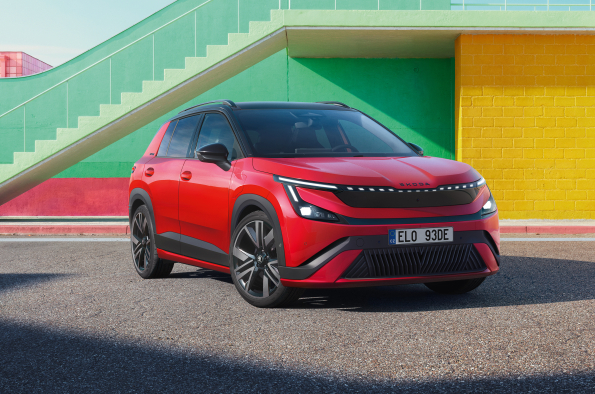
- BEV portfolio: Epiq and Peaq will double Škoda’s BEV range by the end of the year, supporting the Brand Group Core’s goal of making electromobility more accessible
Mladá Boleslav, 31 March 2026 – The agreement signed on 28 March 1991, which brought Škoda Auto into the Volkswagen Group, marked the beginning of a new era for the Mladá Boleslav-based carmaker. Backed by major investments, shared technologies and coordinated development, Škoda has grown into a successful global player active in around 100 markets worldwide. As part of the Volkswagen Group’s Brand Group Core, the brand is helping to make battery-electric mobility more accessible and will double its BEV portfolio by the end of this year with the Epiq and Peaq. At the same time, Škoda has expanded its role as a component manufacturer, supplying engines and transmissions to other Group brands and becoming the Volkswagen Group’s largest producer of BEV battery systems.
Klaus Zellmer, CEO of Škoda Auto, says: “Thirty-five years ago, joining the Volkswagen Group marked the beginning of a remarkable Czech–German success story. Škoda Auto has transformed into a strong, global brand – rooted in its identity, driven by ingenuity, and defined by a clear ‘can do’ attitude. Being part of the Volkswagen Group and the Brand Group Core gives us a powerful foundation to grow and compete. It allows us to benefit from scale, making us faster, more efficient, and better positioned to deliver outstanding value and a broad choice of powertrains to our customers.
Škoda has built a distinct and resilient role within the Group. We are growing successfully in more than 100 markets, with India as a strong second pillar, and we are contributing as a key component hub - supplying engines, transmissions, and today leading in the production of BEV battery systems. Now we are accelerating our electric transformation. With upcoming models like Epiq and Peaq, we are expanding our portfolio and making electromobility more accessible – true to our mission within the Brand Group Core.
This success is built on strong collaboration across the Group, within our company, and with our partners. I want to thank our employees and our trade union partner KOVO for their constructive and reliable cooperation over many years. Together, we combine scale with identity, efficiency with creativity, and tradition with innovation – giving us confidence for the future.”
Škoda Favorit sparked Volkswagen’s interest
The first contacts between Škoda Auto and the Volkswagen Group can be traced back to the 1970s. However, the real catalyst for closer ties between the two carmakers was the development and production of the new Škoda Favorit, introduced in 1987. During talks on potential cooperation and the use of selected components, including powertrains, a Favorit prototype was tested in Wolfsburg. This exchange established important relationships: the highly skilled Škoda specialists made a lasting impression thanks to their ability to respond flexibly to complex development and engineering challenges.
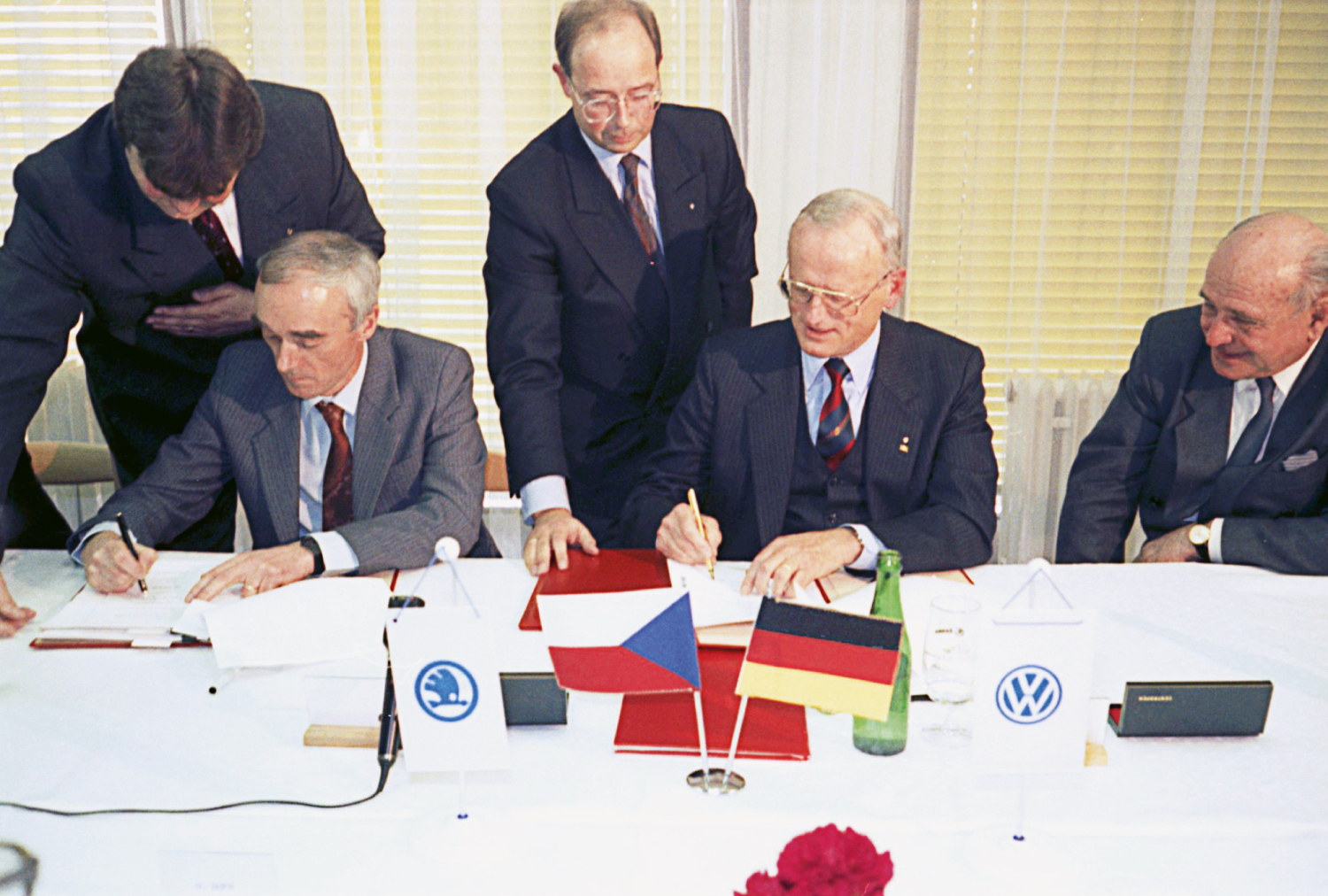
After the fall of the communist regime in Czechoslovakia in November 1989, it became clear that Škoda needed a strong strategic partner to compete in the global market. Annual production capacity stood at around 200,000 vehicles, and the portfolio comprised just two models: the Škoda Favorit and the Forman estate. During the privatisation of the state-owned carmaker, Volkswagen emerged as one of the leading candidates among 24 potential partners. The agreement establishing a joint venture between the Czech government and the Volkswagen Group was signed on 28 March 1991 by Minister of Industry Jan Vrba and Volkswagen Chairman Carl Hahn. After the Volkswagen Group had fulfilled its contractually agreed commitments, it acquired an initial 31 per cent stake in Škoda Auto on 16 April 1991, which was subsequently increased to 100 per cent by 30 May 2000.
Expanding the model portfolio and production capacity to support international growth
Škoda Auto’s development over the following decades was underpinned by an extensive investment programme worth several hundred billion Czech crowns, as well as close coordination with other Group brands. This enabled the company to evolve into an internationally successful car manufacturer with expanding production capacity, a broad model portfolio and access to international markets.
In 2025, Škoda became the third best-selling brand in Europe, delivering more than 1,040,000 vehicles to customers. Alongside its three production plants in the Czech Republic, Škoda today operates production facilities in Slovakia, Kazakhstan and India, mostly through Group partnerships, and manufactures vehicles in Vietnam and Ukraine in cooperation with local partners. With a special focus on India, Škoda is establishing the subcontinent as a strong second pillar alongside Europe, achieving record deliveries there in 2025, driven by its locally developed model line-up: Kushaq, Slavia and, in particular, the Škoda Kylaq. In addition, the company started production in Vietnam and expanded its presence in the Middle East with market entries in Oman and Saudi Arabia.
Driving electric mobility
By the end of this year, Škoda will double its all-electric portfolio with the seven-seater Peaq and the urban crossover Epiq, offering customers even more choice. As part of the Volkswagen Group’s Electric Urban Car Family, the Epiq will help make electric mobility more accessible while leveraging synergies across the Group.
In addition, Škoda is a key component supplier within the Volkswagen Group. With the recent opening of its new battery production facility in Mladá Boleslav, Škoda has become the Volkswagen Group’s largest manufacturer of BEV battery systems. The €205 million investment is part of the Group’s overall battery strategy and supports the faster rollout of new technologies in close cooperation with the Volkswagen Group Technology Center of Excellence Battery.
Contact
|
Vítězslav Kodym |
Kateřina Boukalová |
Škoda Auto
- is successfully steering through the new decade with the Next Level Škoda Strategy;
- aims to become one of the top three best-selling brands in Europe by the end of the decade by offering its customers the best of both worlds through a range of attractive BEV, hybrid & ICE products;
- effectively exploits the potential in important growth markets such as India, Vietnam and the ASEAN region;
- currently offers customers 12 passenger car model ranges: Fabia, Scala, Octavia, Superb, Kamiq, Karoq, Kodiaq, Elroq, Enyaq, Slavia, Kylaq and Kushaq;
- delivered more than 1,040,000 vehicles to customers worldwide in 2025;
- has been part of the Volkswagen Group, one of the world's most successful car manufacturers, for more than 30 years;
- is part of Brand Group CORE, an organisational merger of the Volkswagen Group's volume brands, with the aim of achieving joint growth and significantly increasing the overall efficiency of all five volume brands;
- independently develops and produces components such as MEB battery systems, engines and transmissions for other Volkswagen Group brands;
- operates three production plants in the Czech Republic; has production capacities in Slovakia, Kazakhstan and India, mostly through group partnerships, as well as in Vietnam and Ukraine in cooperation with a local partner;
- employs around 40,000 people worldwide and is active in almost 100 markets.
Photos (1)
Originally published by Skoda
View original article →
Tags
Spotted an issue with this article, or is this your material? Rights holders