More safety on the roads: How Mercedes-Benz contributes with data from real-life traffic

23 June 2026
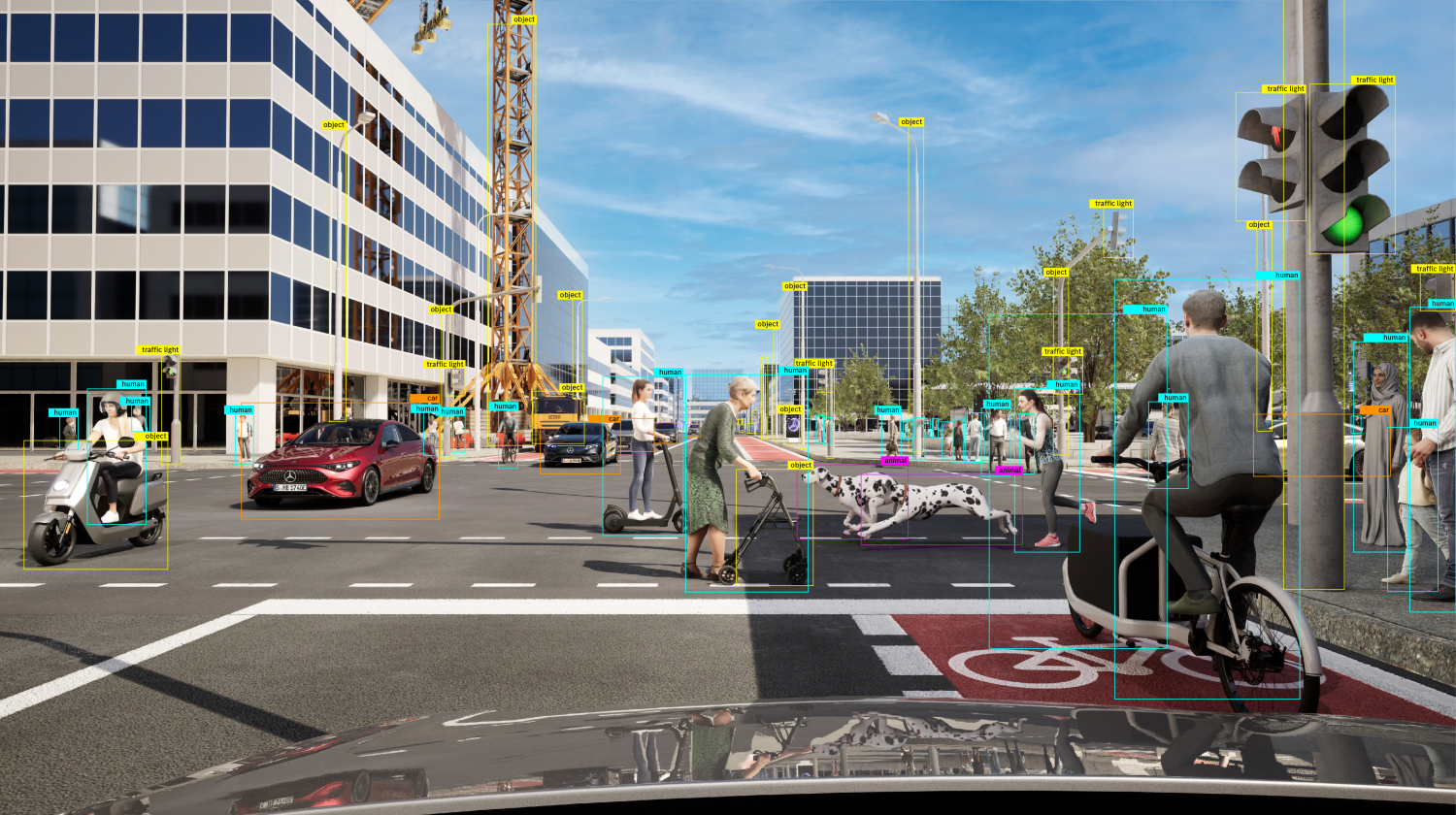
- Mercedes-Benz relies on image, video and sensor data from everyday traffic in the customer fleet to further develop advanced driver assistance systems and automated driving functions
- Data collection with the consent of vehicle owners
- Realistic data makes a significant contribution to improving road safety – for all traffic participants
- Digital responsibility and data protection are prerequisites for the mobility of the future
Stuttgart – Mercedes-Benz is taking a consistent step towards the future in the further development of advanced driver assistance systems and automated driving functions: For this purpose the company will use sensor and video data from the customer fleet to recognise different road users and atypical traffic situations even better in future. The aim is to increase road safety for everyone.
Data is only collected with the consent of the vehicle owner. The company also provides transparent information about the procedure and the use and processing of the data.
Data diversity as the key to road safety
The increasing complexity of road traffic places high demands on assistance and automation functions in vehicles. The more realistically the systems are trained, the safer and more reliably they behave in everyday life. Until now, Mercedes-Benz has relied on data collected from test vehicles worldwide. In order to train automated systems to reliably recognise all types of road users and situations, a wide range of real-life traffic data is required.
The additional data from customer vehicles will enable the systems to react even better to uncommon groups of people such as children, pedestrians, cyclists and people with restricted mobility. The aim is to train the systems with the wide range of situations that they will encounter in the real world. Uncommon traffic situations, such as temporary traffic routing or pop-up cycle paths, or unusual behaviour on the part of road users are also included in the training data.
The variety of data from customer vehicles also helps to identify potential hazards in road traffic. This means that safety can be improved not only in the vehicle itself, but also perspectively through adapted traffic routing or infrastructural measures. The continuous knowledge gained from the customer fleet flows into the optimisation of the driving assistance systems via software updates.
Focus on data protection
Mercedes-Benz attaches great importance to data protection and data security. The company follows the principles of "Privacy by Design" and "Privacy by Default": Data protection and IT security are already firmly anchored in product development.
The data from the customer vehicles is only stored temporarily based on location or events – for example during heavy braking manoeuvres – and then selectively transmitted to the Mercedes-Benz back end. There, the data is usually anonymised and separated from the vehicle identification.
Mercedes-Benz customers decide whether they wish to provide their vehicle data and can revoke this decision at any time.
Road users who have potentially been recorded by vehicles collecting image data can contact Mercedes-Benz, stating the time and place, and request that any recordings be deleted.
Digital trust as part of sustainable mobility
The mobility of the future will be characterised by digital technologies and services. Digital trust is an essential part of sustainable corporate governance at Mercedes-Benz. Our aim is to build and further expand the trust of customers and other stakeholders, such as other road users, in Mercedes-Benz and in the responsible use of digital innovations.
The company pursues an interdisciplinary approach to development: Experts from the fields of development, law, ethics and compliance work closely together from the outset to implement technical innovations responsibly.
Contact:
Johannes Leifert, +49 176 30904735, johannes.leifert@mercedes-benz.com
Vera Pfister, +49 160 8662782, vera.pfister@mercedes-benz.com
Further information about the Mercedes-Benz Group can be found online at: media.mercedes-benz.com and group.mercedes-benz.com
Forward-looking statements
This document contains forward-looking statements that reflect our current views about future events. The words “anticipate”, “assume”, “believe”, “estimate”, “expect”, “intend”, “may”, “can”, “could”, “plan”, “project”, “should” and similar expressions are used to identify forward-looking statements. These statements are subject to many risks and uncertainties, including an adverse development of global economic conditions, in particular a negative change in market conditions in our most important markets; a deterioration of our refinancing possibilities on the credit and financial markets; events of force majeure including natural disasters, pandemics, acts of terrorism, political unrest, armed conflicts, industrial accidents and their effects on our sales, purchasing, production or financial services activities; changes in currency exchange rates, customs and foreign trade provisions; changes in laws, regulations and government policies (or changes in their interpretation), particularly those relating to vehicle emissions, fuel economy and safety or to the communication regarding sustainability topics (environmental, social or governance topics); price increases for fuel, raw materials or energy; disruption of production due to shortages of materials or energy, labour strikes or supplier insolvencies; a shift in consumer preferences towards smaller, lower-margin vehicles; a limited demand for all-electric vehicles; a possible lack of acceptance of our products or services which limits our ability to achieve prices and adequately utilize our production capacities; a decline in resale prices of used vehicles; the effective implementation of cost-reduction and efficiency-optimization measures; the business outlook for companies in which we hold a significant equity interest; the successful implementation of strategic cooperations and joint ventures; the resolution of pending governmental investigations or of investigations requested by governments and the outcome of pending or threatened future legal proceedings; and other risks and uncertainties, some of which are described under the heading “Risk and Opportunity Report” in the current Annual Report or in the current Interim Report. If any of these risks and uncertainties materialises or if the assumptions underlying any of our forward- looking statements prove to be incorrect, the actual results may be materially different from those we express or imply by such statements. We do not intend or assume any obligation to update these forward-looking statements since they are based solely on the circumstances at the date of publication.
Mercedes-Benz Group at a glance
Mercedes-Benz Group AG is one of the world’s most successful automotive companies. With Mercedes-Benz AG, the Group is one of the leading global suppliers of high-end passenger cars and premium vans. Mercedes-Benz Mobility AG specialises in financial and mobility services. The products range from financing, leasing, vehicle subscription, rental and fleet management to insurance, innovative mobility services, digital payment solutions as well as products and services around charging. The company founders, Gottlieb Daimler and Carl Benz, made history by inventing the automobile in 1886. As a pioneer of automotive engineering, Mercedes-Benz sees shaping the future of mobility in a safe and sustainable way as both a motivation and obligation. The company’s focus therefore remains on innovative and green technologies as well as on safe and superior vehicles that both captivate and inspire. Mercedes-Benz continues to invest systematically in the development of efficient powertrains and sets the course for an all-electric future. Mercedes-Benz is consistently implementing its strategy to transform itself toward a fully electric and software-driven future. The company’s efforts are also focused on the intelligent connectivity of its vehicles, autonomous driving and new mobility concepts as Mercedes-Benz regards it as its aspiration and obligation to live up to its responsibility to society and the environment. Mercedes-Benz sells its vehicles and services in nearly every country of the world and has production facilities in Europe, North and Latin America, Asia and Africa. In addition to Mercedes-Benz, the world’s most valuable luxury automotive brand (source: Interbrand study, 10. Oct. 2024), Mercedes-AMG, Mercedes-Maybach as well as the brands of Mercedes-Benz Mobility: Mercedes-Benz Bank, Mercedes-Benz Financial Services and Athlon. The company is listed on the Frankfurt and Stuttgart stock exchanges (ticker symbol MBG). In 2024, the Group had a workforce of around 175,000 and sold around 2.4 million vehicles. Group revenues amounted to €145.6 billion and Group EBIT to €13.6 billion.
Originally published by Mercedes-Benz
View original article →
Tags
Spotted an issue with this article, or is this your material? Rights holders