Mercedes-Benz puts CLA safety to the ultimate real-world test

20 October 2026
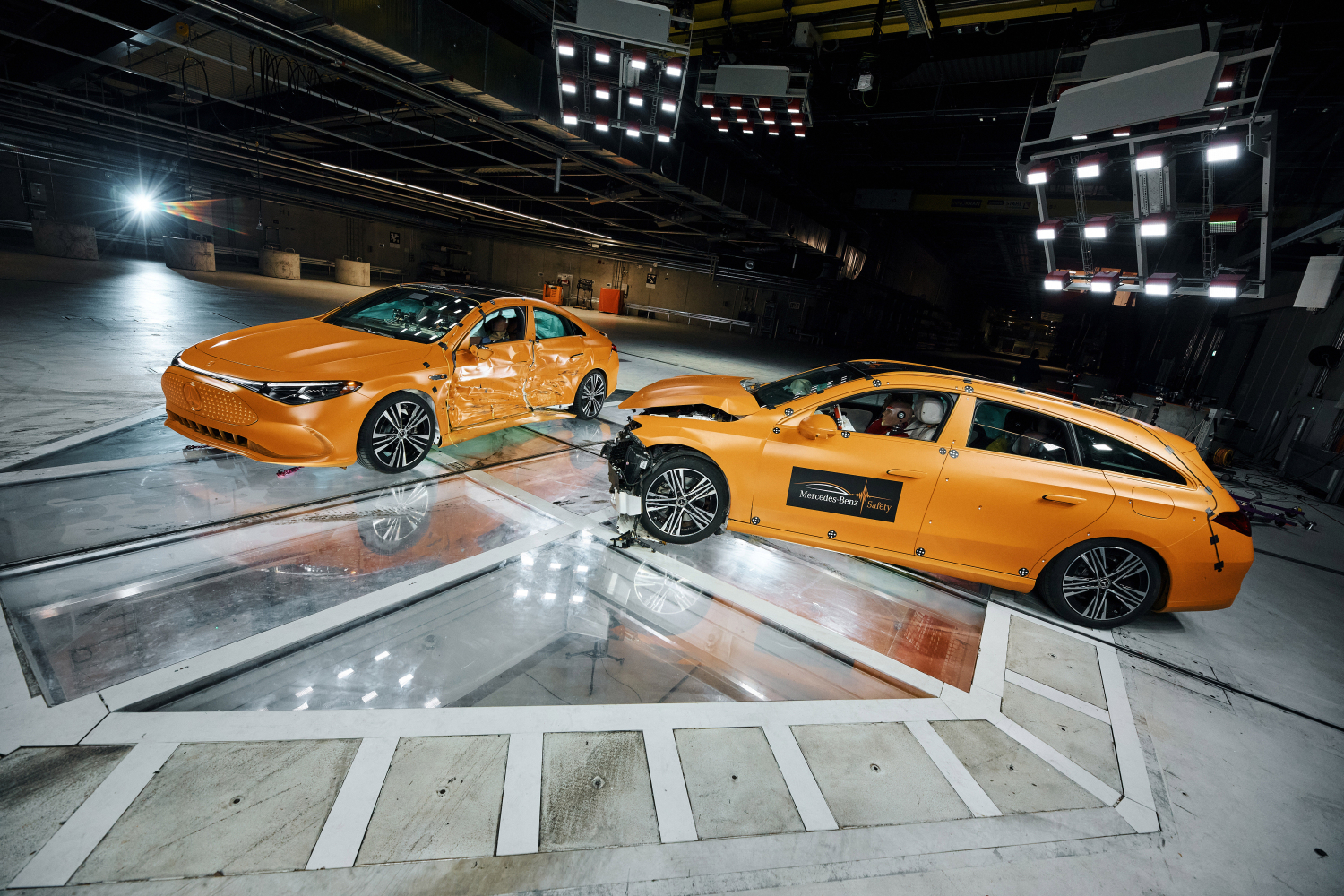
World’s first public high-speed side-impact crash test involving two CLAs demonstrates outstanding occupant and battery protection
- The CLA’s driver assistance systems are designed to prevent this type of collision or reduce its severity in everyday traffic
- In the test, a CLA Shooting Brake with an electrified internal combustion engine collided with the driver’s side of a fully electric CLA – both vehicles were travelling at 56 km/h
- The scenario, which was deliberately designed to be particularly challenging, combined an unchecked side-impact collision, two vehicles each weighing more than two tonnes, and a speed that was significantly higher than is usual in urban traffic
- Both vehicles offered outstanding occupant protection; the high-voltage battery in the electric CLA remained undamaged
- Mercedes‑Benz Rescue Intelligence, demonstrated for the first time, is designed to provide emergency services with key information about accidents whilst they are still on their way to the scene
Stuttgart. Mercedes‑Benz has shown the world's first live high-speed side-impact crash test with two production vehicles. Both vehicles were travelling at 56 km/h – an exceptionally demanding practical test for the safety of the new CLA. In everyday traffic, the CLA’s modern driver assistance systems would help drivers to avoid such a collision or reduce its severity. To test the two vehicles, each weighing more than two tonnes, Mercedes‑Benz conducted the crash test – as is customary for such tests – without prior braking. A CLA Shooting Brake with electrified combustion engine drove directly into the driver’s side of an all-electric CLA.
That is a high-speed and extremely severe side-impact collision. According to Mercedes-Benz’s own accident research, a speed of 56 km/h for both vehicles is at the upper end of junction accidents that occur in real-world traffic scenarios. Furthermore, the speed is higher than the speeds normally encountered in city-centre traffic. As there is considerably less space available on the side of the vehicle for energy absorption than at the front, this type of crash test scenario is considered one of the most critical types of accident for occupants and the vehicle structure. The chosen scenario is also particularly challenging, as the all-electric CLA is struck in the side by the other vehicle. These are precisely the areas that require the highest level of protection: the passenger compartment and, in the case of fully electric vehicles, the high-voltage battery housed in the underbody.
The result: Both CLA models provided their occupants with exceptionally good protection
The passenger compartments of both vehicles remained intact. The readings from all eight crash-test dummies, representing four adults and four children, remained below the relevant biomechanical limits. These limits are used within the industry to assess occupant protection. And the dummy readings indicate that all safety systems worked as intended for one reason: to keep the occupants as safe as possible. The data, comprising up to 150 measurement points per dummy, confirmed the effectiveness of the vehicles’ safety systems. The results indicate that there is a low risk of serious or life-threatening injuries to the occupants. Also, the high-voltage battery itself remained intact and undamaged, despite the direct and severe side impact.
“Mercedes-Benz’s ambition is to build the safest vehicles in the world. That is why we develop safety systems that address real-world traffic scenarios. The world's first public intersection crash test conducted in this configuration is a powerful demonstration of that ambition.”
Jörg Burzer, Member of the Board of Management of Mercedes-Benz Group AG,
Chief Technology Officer, Development & Purchasing
Why this test goes beyond the standards
No law and no safety rating requires a side-impact crash test involving two real vehicles. Standard tests are carried out against stationary barriers or so-called impact vehicles under specified conditions. However, Mercedes-Benz opted for two moving production vehicles and a scenario based on real-world accident data. The test speed of 56 km/h represents the upper end of the real-world range for serious junction collisions. And: Around a quarter of accidents resulting in personal injury are side-impact collisions. The test therefore demonstrates how its holistic safety concept performs in an unusually severe real-life accident scenario.
“If you want to build the safest vehicles, you need to incorporate insights from real-world accidents into your vehicle development requirements. We call this Real-Life Safety. This test involving two CLA models demonstrates how we successfully translate that approach into reality.”
Paul Dick, Director of Vehicle Safety, Mercedes-Benz AG
Safety, developed from real-life scenarios
Mercedes‑Benz has been investigating and reconstructing real-life accidents since 1969. A total of around 6,000 accidents were analysed – jointly by research teams in Germany, China and India. The findings are incorporated into body structures, restraint systems and the company’s own requirements.
Long before a new Mercedes‑Benz vehicle is subjected to a physical crash test, it has already completed extensive virtual testing. During the development process, every new model undergoes around 15,000 crash simulations. Artificial intelligence supports our engineers in making these predictions even more precise. Overall, Mercedes‑Benz carries out around 150 physical crash tests for a new model, going well beyond legal requirements in pursuit of the high safety standards.
Mercedes‑Benz Rescue Intelligence: Faster information for rescue services
The car manufacturer has unveiled ‘Mercedes‑Benz Rescue Intelligence’ for the first time. The system is set to be rolled out gradually from 2027 onwards and will then establish a direct link between vehicles involved in accidents and the emergency services. This will enable the fire service to access accident-related information whilst en route. Depending on technical availability and the specific situation, the system can then display the number of occupants, the status of airbags and seat belts, which doors are open, the battery temperature and the condition of the high-voltage system. This information can help emergency services gain an overview of the situation even before they arrive, enabling them to prepare for the operation more effectively than is currently possible. This enables emergency services to select the appropriate rescue equipment sooner, as every second counts following an accident.
Contact:
Tim In der Smitten, +49 151 58 617 626, tim.in_der_smitten@mercedes-benz.com
Matthias Struck, +49 176 30 925 774, matthias.struck@mercedes-benz.com
Mercedes-Benz anniversary year “140 Years of Innovation”
Since Carl Benz filed the patent for the first automobile 140 years ago and Gottlieb Daimler built his motorised carriage shortly afterwards, Mercedes-Benz has dedicated itself to constant innovation and to creating the world’s most desirable cars for customers. This ambition has driven every innovation – from the world’s first automobile in 1886 to the biggest product launch programme in the company’s history that is currently underway. With its passion for performance and pioneering power, excellence and an unwavering commitment to customer service, the brand has consistently shaped the future of mobility. The result goes well beyond engineering achievement – it creates the unmistakable feeling that runs through everything Mercedes-Benz does: Welcome home.
Mercedes‑Benz is celebrating 140 years of innovation: Three new S-Class saloons went on a trans-continental journey to 140 locations worldwide as part of the “140 Years. 140 Places” tour. Each place highlighted the brand’s technology, heritage, pioneering spirit and worldwide presence. Along the way, customers, fans and colleagues got to join in the celebrations right up to its grand ‘Homecoming’ finale at the Mercedes-Benz Museum. Highlights of the tour can be found on our “140 Years of Innovation | Mercedes‑Benz Media” special.
Further information about Mercedes-Benz is available at https://www.mercedes-benz.com/en/and on our LinkedIn channel under Mercedes-Benz AG | LinkedIn. Press information and digital services for journalists and multipliers can be found on our Mercedes-Benz Media online platform at media.mercedes-benz.com.
Mercedes-Benz AG at a glance
Mercedes-Benz AG is part of the Mercedes-Benz Group AG with a total of around 164,000 employees worldwide and is responsible for the global business of Mercedes-Benz Cars and Mercedes-Benz Vans. Ola Källenius is Chairman of the Board of Management of Mercedes-Benz AG. The company focuses on the development, production and sales of passenger cars, vans and vehicle-related services. Furthermore, the company aspires to be the leader in the fields of electric mobility and vehicle software. The brand portfolio of Mercedes-Benz Cars includes the Mercedes-Benz brand, as well as Mercedes-AMG, Mercedes-Maybach, and the G-Class product brand. Mercedes-Benz AG is one of the world’s largest manufacturers of high-end passenger cars. In 2025 it sold more than 2.1 million passenger cars and vans. In its two business segments, Mercedes-Benz AG is continually expanding its worldwide production network with around 30 production sites on four continents. Sustainability is a guiding principle of the Mercedes-Benz strategy. Mercedes-Benz considers the impacts of its business activities across the entire value chain and takes economic, environmental and social aspects into account in equal measure.
Photos (15)
Originally published by Mercedes-Benz
View original article →
Tags
Spotted an issue with this article, or is this your material? Rights holders