Stage Presence: Nine Cars That Define Ford's Rally History
1 October 2026
At Ford, rallying is in our blood. This uniquely challenging motorsport has helped shape driving character, durability and kerb appeal through generations of our cars in Europe, and is set to inspire a new generation of five rally-bred models by 2029.
As we announce our return to WRC in 2028 with a factory team for the first time since 2012, there’s no better time to revisit some of the icons that helped earn our special place in rally history.
And there’s no better person to help us look back at those cars than Malcolm Wilson OBE. A rallying legend, Malcolm is an accomplished former Ford rally driver as well as founder and managing director of M-Sport Ltd, Ford’s partner in rally adventures since 1997.
Malcolm Wilson OBE
Malcolm Wilson began competitive rallying in 1974 driving Ford Escorts, winning the UK National Championship in 1978 and 1979, the British Rally Championship in 1995 and has two World Rally Championship podium finishes.
Wilson’s M-Sport managed the Ford Rally Team from 1997, culminating with victory in the WRC Manufacturers’ title in 2006, 2007 and 2017. Wilson was awarded an OBE in 2009 and in 2025 was confirmed as Deputy President for Sport at the FIA.
Mk I Escort — 1968-1974
Fast but tough and reliable, the first-generation Escort showed its capabilities by winning the epic World Cup Rally in 1970, which covered more than 40,000 kilometres between London and Mexico City.
Ford introduced several iterations of high-performance Escort to boost its competitiveness on the rally stage, with the Twin Cam, Mexico, RS1600 and RS2000 versions. The Escort Mk I RS1600 recorded its first World Rally Championship (WRC) win at the 1973 1,000 Lakes rally in Finland, while RS1600s finished first, second and third in that year’s RAC Rally in Great Britain.
Mk II Escort — 1974-1982
The second-generation Escort carried on where its predecessor left off, with the Rallye Sport road cars benefitting from numerous fine-detail improvements with the goal of improving the competition cars. The Escort Mk II RS1800 led the line for Ford on the WRC stage, and in 1979 completed the double of both the driver and manufacturer championships with Björn Waldegård at the wheel.
The RS1800 secured a second driver’s title in 1981 for Ari Vatanen, despite growing competition from four-wheel drive rivals.
RS200 — 1985-1986
The RS200 was a radical departure from previous Ford WRC competitors, being designed specifically as a rally car from the outset, with only 200 road-going examples sold in order to meet Group B homologation regulations. Powered by another Cosworth-developed engine, the mid-engined RS200 featured four-wheel drive with selectable power distribution to suit different rally types, a fibreglass body and twin dampers at each corner.
Despite registering a podium in only its second outing of the 1986 season, the RS200’s competition career was curtailed when Group B was outlawed as a rallying category for 1987.
Sierra RS Cosworth — 1987-1992
An instant success in circuit racing, the Sierra RS Cosworth used a turbocharged engine based on Ford’s 2.0-litre Pinto unit and developed by Cosworth to produce 204 PS in road-going trim. Despite lacking the advantage of four-wheel drive, the Sierra RS Cosworth’s performance and toughness meant it was a regular podium finisher, and it won the 1988 Corsica Rally outright ahead of two four-wheel drive rivals.
The year 1990 saw the introduction of the Sierra Sapphire RS Cosworth 4x4, which achieved seven podium finishes in subsequent seasons.
Escort RS Cosworth — 1993-1998
Seeking to create a lighter and more nimble car for competitive rallying, in 1993 Ford introduced the Escort RS Cosworth. Despite its outward appearance, underneath the Escort shared elements of its drivetrain and chassis with the Sierra RS Cosworth, but the smaller overall dimensions and imposing front and rear wings improved manoeuvrability and performance on the rally stages.
It was an instant success, taking second and third places on its debut and five outright wins in its first season.
Mk I Focus WRC — 1999-2004
In 1999 Ford introduced the Focus RS WRC, based on the first-generation Focus road car. It achieved two wins in its debut season including the notoriously demanding Safari Rally Kenya and a further 14 victories, and missed out on winning the driver’s championship in the 2001 season by a single point.
Mk II Focus WRC — 2005-2010
The Focus RS WRC 06 arrived in 2005, using the then-new second-generation Focus as its base, with better aerodynamics and a stronger bodyshell contributing to the rally car’s performance. In 2006 it took eight victories, securing Ford’s first manufacturer’s championship since 1979, a title it successfully defended the following year.
Across the two generations, the Focus RS WRC competed in 173 events, achieving two world championships and 142 podiums including 44 event wins.
Fiesta WRC — 2011-2021
To meet the new World Rally Car regulations, Ford created the Fiesta RS WRC for the 2011 season, using a 1.6-litre EcoBoost turbocharged engine and taking three victories that year, as well as 18 podiums including three victories in 2012. It scored a further 16 podiums before the new Fiesta WRC was introduced in 2017.
With increased aerodynamic performance, the Fiesta WRC secured the Drivers, Co-Drivers and Manufacturers Championships in 2017 with Sébastien Ogier and Julien Ingrassia, and retained the Driver and Co-Drivers Championships the following year.
Puma Rally1 — 2022-on
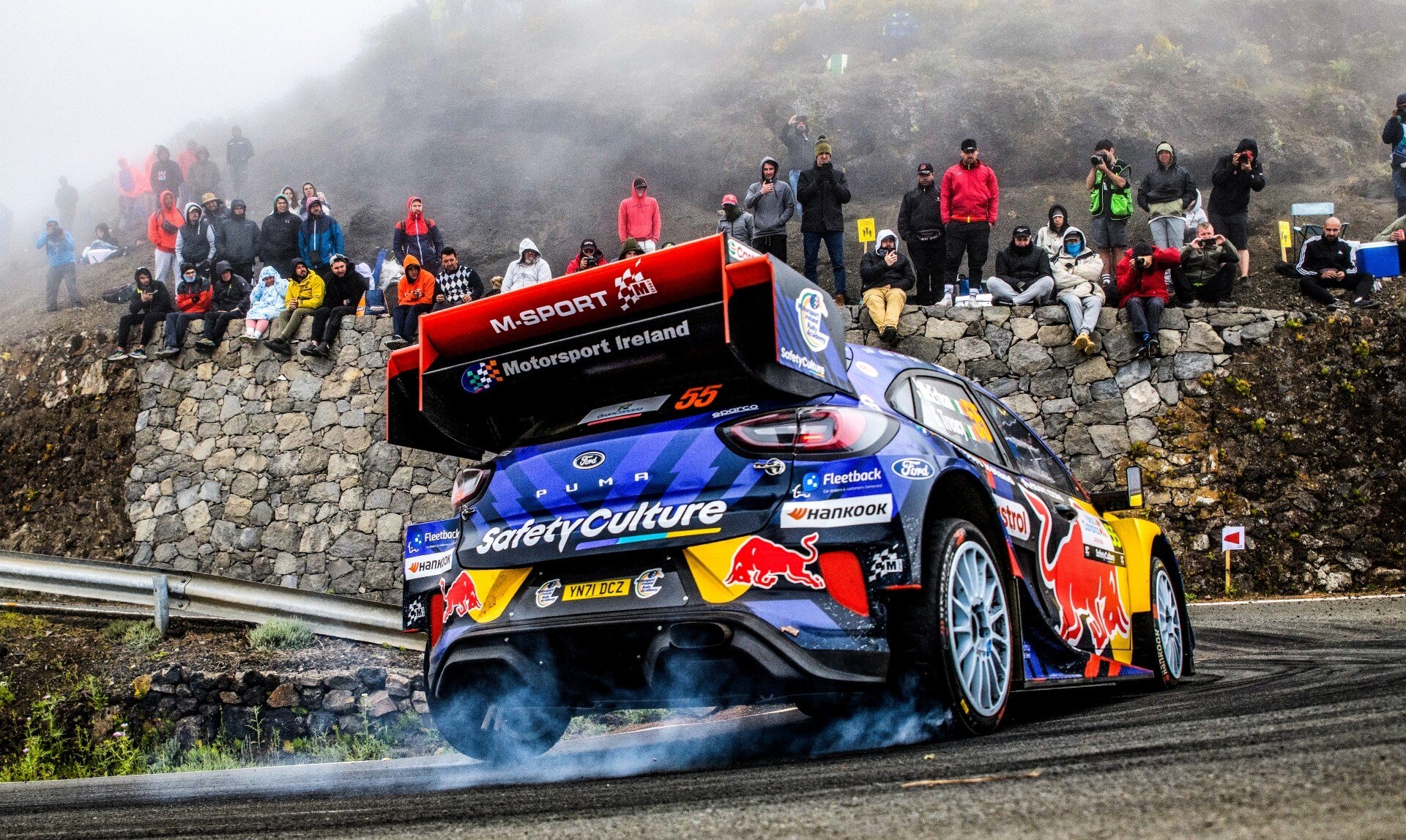
The Puma arrived in 2022 to meet the new WRC Rally1 regulations, which included the use of synthetic fuels and a hybrid powertrain system, creating another technological link to the road-going Puma 1 and its EcoBoost Hybrid engines.
The Puma Rally1 won on its first outing in the challenging mixed-surface Monte Carlo Rally and scored two further victories and eight podiums in subsequent seasons.
Matt Joy is a writer for From The Road
1 Puma EcoBoost Hybrid CO2 emissions 119-146 g/km and fuel efficiency 5.3‑6.5 l/100 km WLTP. The declared WLTP fuel/energy consumptions and CO2-emissions are determined according to the technical requirements and specifications of the European Regulations (EC) 715/2007 and (EU) 2017/1151 as last amended. The applied standard test procedures enable comparison between different vehicle types and different manufacturers.
Photos (30)
Originally published by Ford
View original article →
Tags
Spotted an issue with this article, or is this your material? Rights holders


