Drone Ranger: Team UAV Turns Pickups Into Off-Road Aircraft Carriers

20 July 2026
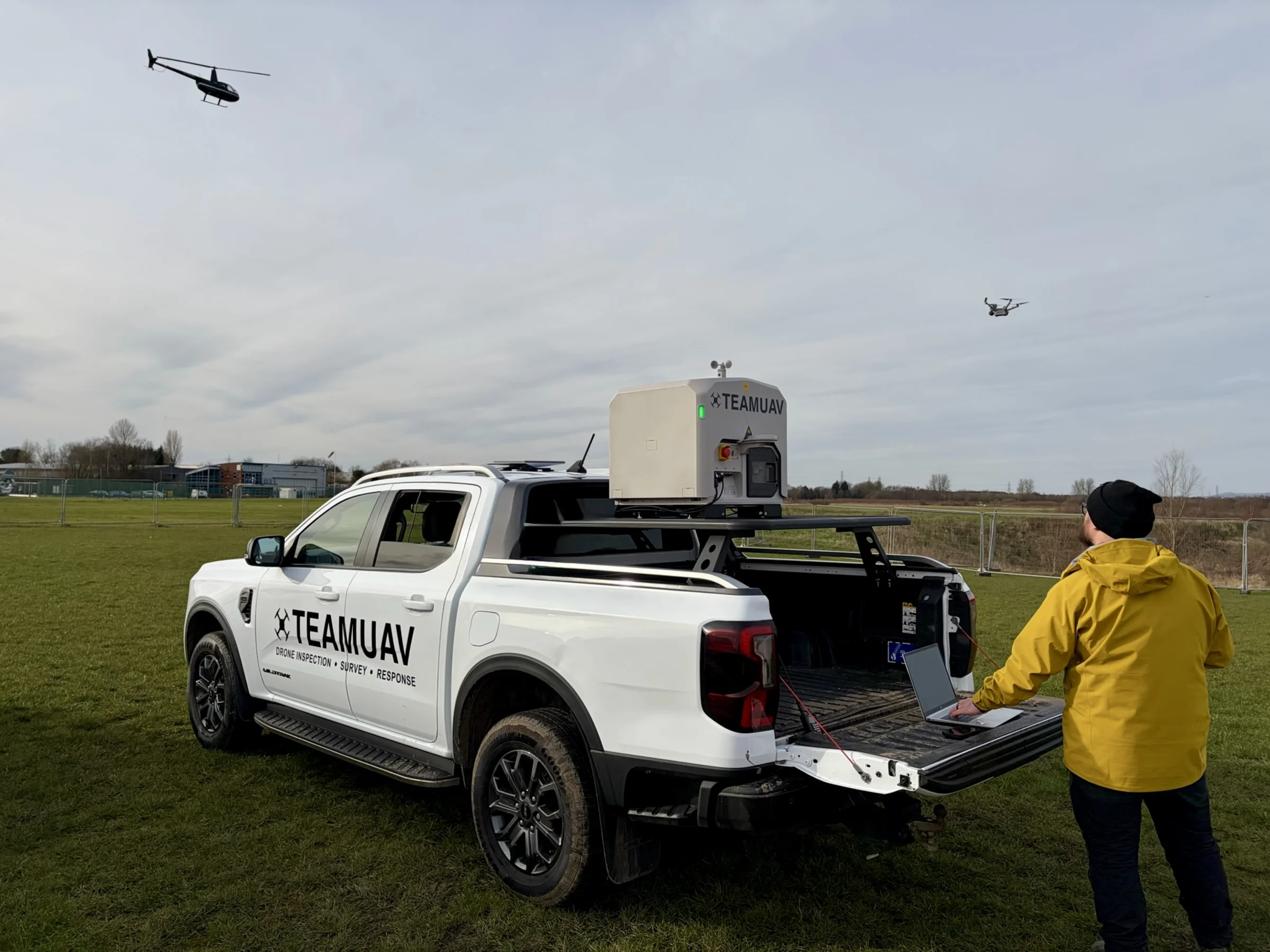
Inspecting buildings used to be a nightmare. For something big like a major hospital, you'd have to scaffold the whole building every five years. It took months, cost a fortune, and can't have been pleasant for the staff or patients. To inspect anything bigger — a forest or large event site, for example — you'd need a helicopter.
Today, drones can do a faster, cheaper and less intrusive job. Since I started Team UAV, that's been the backbone of our work. It all started in the Niger Delta back in 2013. I'd left the army and was working as a security consultant on pipelines, transferring my military expertise in surveillance to civilian drone projects.
This convinced me that there was a market for drone work and once back in the UK, Team UAV was born. We've come a long way since then; our first report included literally thousands of numbered and printed A4 photos but today, we can live-stream high-definition footage to experts or create maps and 3D models for customers of whatever our drones see.
That level of tech means lots of our work is putting an eye in the sky where a human can’t easily or safely go — think inspecting pylons, bridges and wind turbines, surveying the impact of flooding, or even feeding data into a UK Government COBRA emergency response meeting.
Drones are the front line of the business, but they still need to reach the site. That’s where our Ford Ranger 1 conversions come in. They’re basically a mini aircraft carrier, giving us a self-contained base to fly from wherever our drone crews are needed.
Lots of our work involves disaster response in remote areas, so off-road capability is essential. The Ranger’s wading capability is a big plus when we’re driving through floodwater to launch a damage assessment, or accessing a mountain or forest for environmental survey.
The set up in the load bed is actually fairly simple. We decided to use an off-the-shelf accessory tray as the basis, so we can move the kit between our fleet or even bolt it into a Ranger on short-term hire for a large contract if needed.
We need to be totally self-contained on site, so we use an inverter to power our software, connectivity and communications kit as well as the drone dock itself and battery chargers. As power is so essential to our on-site work, we also use solar panels and extra batteries.
Knowing our Ranger fleet is available to reach almost any site and turn it into a high-tech office and launchpad is a major differentiator for Team UAV, which has helped us support vital healthcare, infrastructure and safety-critical projects across the country.
As I write this, our off-road aircraft carriers are in the Scottish Highlands surveying pylons before going on to protect some of the UK’s critical infrastructure projects carrying out perimeter security work.
It’s a long way from my time in the military or those early days in the Niger Delta, but I love that I still get to be part of a tight-knit team developing new ways to get tough jobs done.
Lewis Pritchard is the Founder and Managing Director of Team UAV.
1 Ford Ranger V6 diesel homologated CO2 emissions 269-333 g/km WLTP Euro 6e-bis, homologated fuel efficiency 10.2-13.8 l/100 km WLTP Euro 6e-bis. The declared WLTP fuel/energy consumptions and CO2 emissions are determined according to the technical requirements and specifications of the European Regulations (EC) 715/2007 and (EU) 2017/1151 as last amended. The applied standard test procedures enable comparison between different vehicle types and different manufacturers.
2 Always consult the Owner’s Manual before off-road driving or driving through water, know your terrain and trail difficulty, and use appropriate safety gear.
Photos (4)
Originally published by Ford
View original article →
Spotted an issue with this article, or is this your material? Rights holders


